
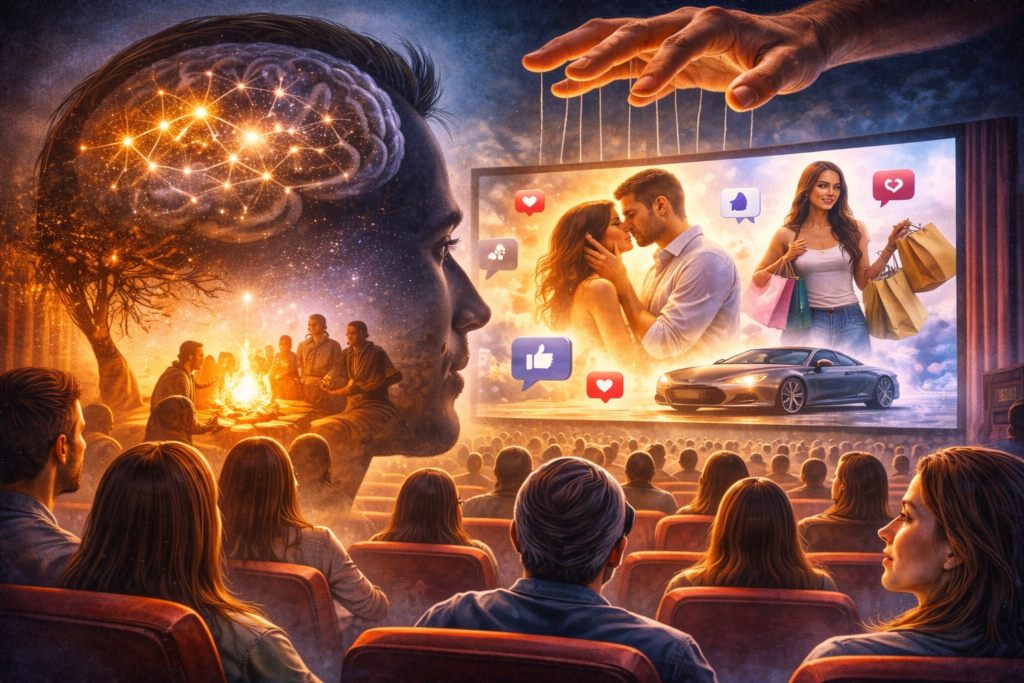
When people sit inside a dark hall and a screen lights up in front of them, something far more than entertainment begins. For a few hours, they lend their nervous system to another person’s imagination. The body remains in the seat, but the mind travels into a world constructed by a director, a writer, and a camera. The audience breathes when the hero breathes, fears when the villain appears, hopes when love is promised, and grieves when loss is shown. In this quiet transaction, the mind opens itself — and whatever enters an open mind leaves a trace.
This is not new. Long before cinema existed, human beings gathered around fires to listen to storytellers. Tribes survived not only through hunting and farming but through stories that taught courage, loyalty, fear, and morality. When Homer recited The Iliad, warriors imagined themselves as Achilles. When the Ramayana was sung in ancient India, generations absorbed ideals of duty, sacrifice, and honor. The human brain evolved to learn through narrative. Stories are not decorations of culture; they are the software of the mind.
Modern films are simply the most advanced form of storytelling we have created — combining light, sound, faces, music, and movement into one sensory stream. Neuroscience shows that when we watch a character experience something emotional, our mirror neurons activate as if we ourselves were experiencing it. A child watching a brave hero does not merely observe courage; he rehearses courage inside his nervous system. A teenager watching betrayal rehearses distrust. A couple watching idealized romance rehearses expectations that real life may never satisfy.
This is why visual media is so powerful. The brain does not fully separate imagined experience from lived experience. A soldier can have trauma from war, but a person can also have trauma from repeatedly watching violence. The stress hormones released during intense scenes — adrenaline, cortisol — are real. The dopamine released during pleasure scenes is real. These chemicals shape memory, desire, fear, and belief.
In ancient times, priests, poets, and elders carried this influence. Today, filmmakers, advertisers, and social platforms do.
There is a story from ancient Greece about the Sirens — beautiful singers whose songs were so enchanting that sailors would steer their ships into the rocks just to hear them, destroying themselves in the process. Odysseus survived only by ordering his crew to tie him to the mast and block their ears with wax. The story is ancient, but the warning is modern: not all that is beautiful is safe, and not all that feels good is good for us.
Cinema is our modern Siren. It sings of love without responsibility, power without discipline, pleasure without consequence. Sometimes it inspires greatness — as when young athletes watch champions and train harder, or when someone sees a story of resilience and chooses not to give up. But it also quietly programs desire, normalizes excess, and reshapes values without asking permission.
A child who grows up watching heroes solve problems with violence may come to feel that force is a natural solution. A teenager raised on romantic fantasy may feel disappointed by ordinary human love. A society flooded with images of luxury may start feeling poor even when it has enough.
This is not because people are weak. It is because the brain is plastic. It changes according to what it consumes.
Even color itself, which feels so objective, is an internal construction. Dogs see fewer colors than humans. Bees see ultraviolet patterns we cannot see. What we call “reality” is already an interpretation created by our brain. When films enter that interpretation repeatedly, they begin to shape what feels normal, desirable, and meaningful.
History shows us this pattern again and again. The Roman Empire used spectacles in the Colosseum to distract the masses from political decay — “bread and circuses,” as the philosophers said. The crowds were entertained while power consolidated elsewhere. Today, screens replace the Colosseum, and content replaces gladiators, but the mechanism is unchanged.
This is why the question is not whether films are good or bad. The question is whether we are conscious while consuming them.
A knife can cook food or kill. Fire can warm a home or burn it down. A story can heal or hypnotize.
Real freedom does not mean rejecting media. It means not being owned by it. It means choosing what enters your mind the way you choose what enters your body. It means understanding that every image you watch is a seed, and every repeated emotion is a pattern being written into you.
In the end, the most important story is not the one on the screen. It is the one you are writing with your own attention, habits, and choices.
Your life is the real film. Your thoughts are the script. Your actions are the scenes. Watch carefully what you watch — because slowly, quietly, it becomes what you are.